
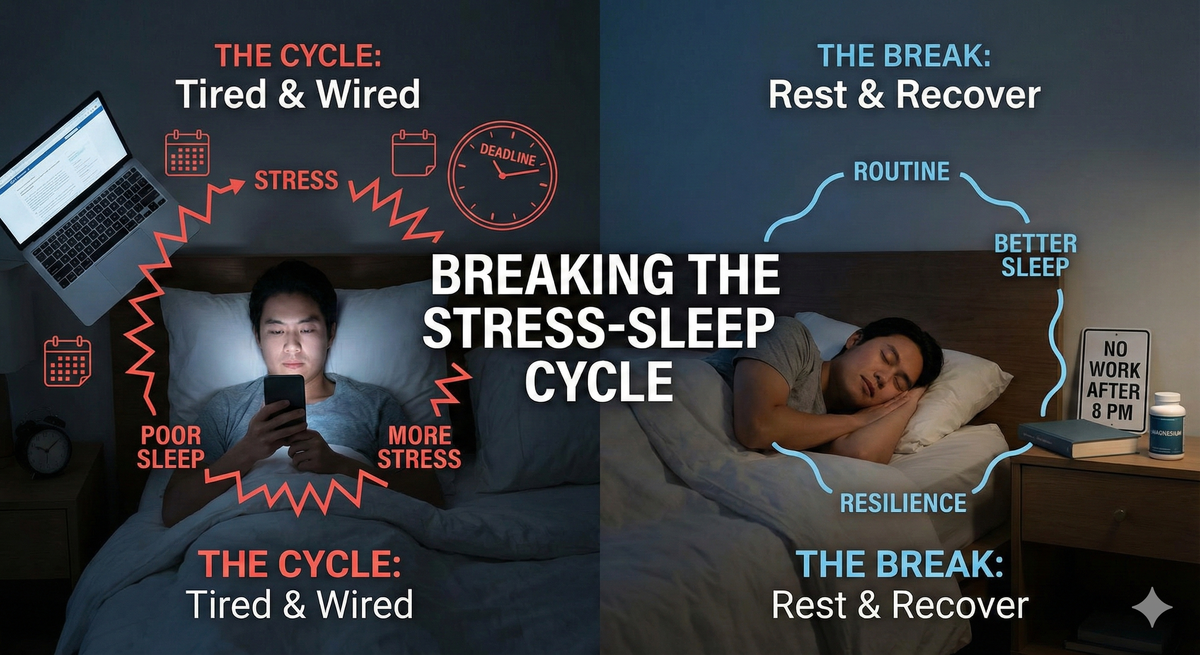
For about eight months, I honestly forgot what it felt like to sleep normally.
It started when I got promoted. Great news on paper. More responsibility, more money, more recognition. But also more pressure, longer hours, constant deadlines, and this heavy sense that I should always be doing something.
At first the sleep problems were occasional. A rough night here and there. Nothing alarming.
Then it got frequent.
Then it was every night.
I’d lie in bed, completely worn out, but my brain refused to shut off. I’d replay meetings, plan tomorrow’s tasks, stress over emails, and spiral about things that hadn’t even happened yet.
My body felt drained. My mind was in overdrive.
And the more I couldn’t sleep, the more stressed I became about not sleeping. That loop almost broke me.
The mental stress was bad enough, but my body joined the chaos.
Jaw tension: I was clenching so hard at night that I’d wake up with headaches. My dentist pointed out I had started grinding my teeth.
Neck and shoulder tightness: I’d go to bed stiff and wake up stiff, like my body never relaxed.
Elevated heart rate at night: Not racing, but just high enough to feel uncomfortable. Like a subtle internal alarm.
Those 2–4 AM wake-ups: No noise. No reason. Just suddenly wide awake with a stressed mind.
Shallow, broken sleep: I’d be in bed for 7–8 hours but wake up feeling like I never slept. My fitness tracker backed it up: almost no deep sleep.
Stress wasn’t just in my head. It was showing up everywhere.
Stress ruins sleep. Poor sleep increases stress. That cycle took over my life.
A typical week looked like this:
Monday: Stress → can’t sleep → 4 hours of rest
Tuesday: Exhaustion makes the smallest thing overwhelming → worse sleep
Wednesday: Now stressed about work and sleep → maybe 3 hours of broken rest
Thursday: Running on fumes → sleep gets worse
Friday: I’m barely functioning
Weekends helped only because I was so exhausted. Then Monday reset the cycle again.
I was irritable, anxious, getting sick often, and making mistakes I never used to make. I cried easily. I snapped at people I loved. And I kept telling myself, “Once work calms down, I’ll sleep again.”
Work never calmed down.
After a lot of late-night searching, I learned the biology behind this.
Stress raises cortisol. Cortisol should rise in the morning and fall at night.
Under constant stress? It stays elevated. The body thinks it’s in danger.
That’s why:
I felt “tired but wired.”
My muscles stayed tense.
I woke up at 3 AM.
I couldn’t fall into deep sleep.
My body wasn’t malfunctioning. It was doing exactly what it’s designed to do in danger. The problem was that the “danger” never stopped.
I tried everything. Most of it didn’t work. But these did.
Taking magnesium an hour before bed softened everything:
Less jaw clenching
Relaxed muscles
Shoulders not glued to my ears
Easier to fall asleep
It didn’t fix everything, but it removed the physical roadblocks.
Magnesium calmed the body. Inositol helped the mind.
It reduced the racing thoughts and nighttime anxiety. Not silence, but something manageable. It helped control spiraling and overthinking.
This became non-negotiable.
Warm water relaxed my muscles and brought me out of “work mode.” The drop in body temperature afterward signaled that it was time to sleep.
It worked every time.
No work after 8 PM.
No emails. No planning. No mental rehearsing.
It took discipline, but late-night work kept me wired for hours. Creating a cutoff helped my brain wind down instead of spinning until 2 AM.
The 4-7-8 method became my go-to tool. It slowed my heart rate and forced my body into a calmer state.
I’d use it:
Before sleep
During those 3 AM wake-ups
Anytime my chest felt tight
It didn’t sedate me, but it made sleep possible.
I kept a notebook by my bed and wrote everything circling my mind. Tasks, worries, reminders, random thoughts.
Getting it out of my head made space for rest.
Late meals kept my body working when it needed to wind down.
Moving dinner to 7:30–8 PM helped my sleep settle.
No scrolling in bed. No late-night emails. No stimulation.
I kept my phone in another room after 9:30 PM. The first week was uncomfortable, but after that, it was freedom.
Chamomile or lavender tea became part of my wind-down routine. It helped shift my brain into a calmer state.
Along with magnesium and inositol:
Ashwagandha in the evening for high-stress days
Occasional melatonin when my schedule got disrupted
Magnesium lotion on tight shoulders and jaw
These weren’t magic, but they helped my nervous system settle.
It didn’t happen overnight, but slowly:
I started falling asleep in 20–30 minutes instead of hours.
The 3 AM wake-ups became rare.
My jaw stopped hurting.
My patience came back.
Work didn’t feel as crushing.
My mood evened out.
I stopped getting sick all the time.
The cycle finally broke.
Here’s what I wish someone had told me:
This isn’t weakness. It’s physiology.
You need to calm both the body and the mind.
Boundaries around work are essential.
Your wind-down routine matters more than you think.
Consistency is the secret sauce.
And if it becomes too much, get help. There’s no shame in that.
I thought sleep would return once work got easier.
But sleep improved when I changed how I handled stress.
Work stress didn’t disappear. My nervous system stopped being hijacked by it because I gave it support, structure, and recovery time.
Now when life gets stressful, I still sleep. I have tools. I have routines. I don’t spiral anymore.
Those eight months were brutal. Sleep deprivation affects everything — your health, your mood, your relationships, your ability to think.
Perks, first drops, sleep science.
Shut Up & SLEEP
© 2025 ZIIST. All rights reserved.
theziist.com