
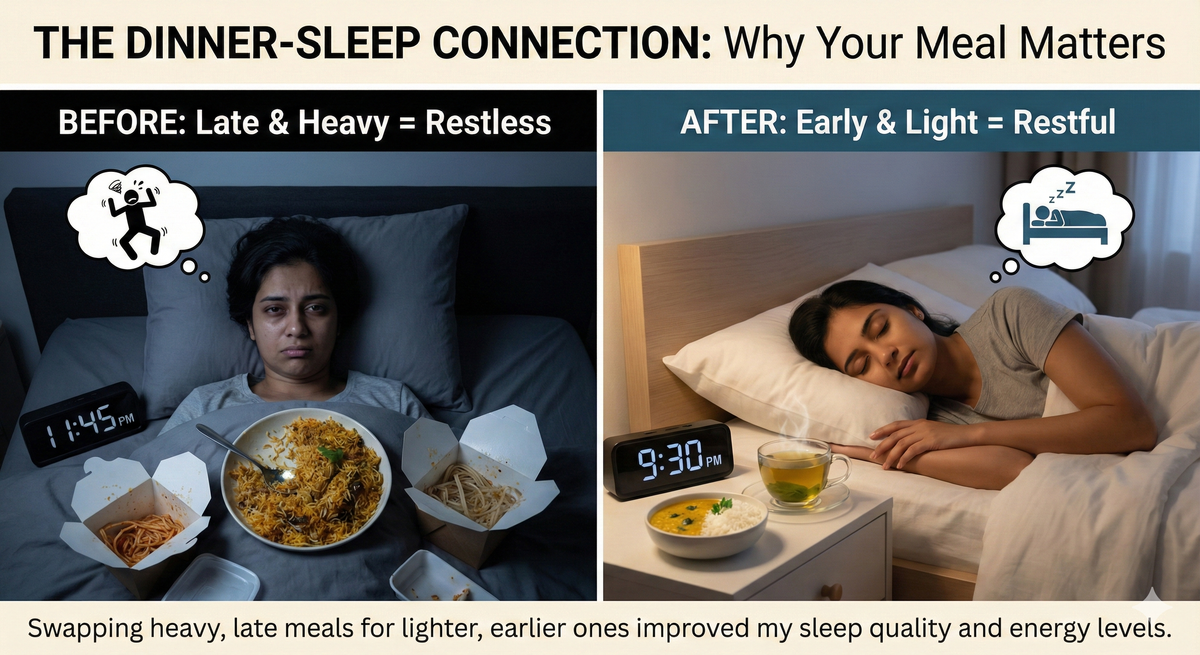
I was doing everything right for sleep. Good routine, magnesium, no screens before bed. Things improved a little, but something still felt off. I’d lie awake with this heavy, uncomfortable feeling. Not quite indigestion. Just… wrong.
One night I told my mom about it. She asked the simplest question: “What are you eating for dinner?”
I told her I usually ordered biryani around 9:30 or 10. Sometimes chole bhature. Sometimes butter chicken with naan.
The look she gave me said everything.
That’s when it hit me. I’d obsessed over routines, lights, supplements, and stress. I never stopped to think about the most obvious thing: my food habits.
How My Evenings Actually Looked
Living alone and working long hours meant eating whenever I could. Usually late.
My routine looked like this:
-
Work till 8:30 or 9
-
Decide about dinner around 9:30
-
Order something heavy
-
Eat by 10 or 10:30
-
Try to sleep by 11:30 or midnight
It felt normal. Everyone I knew ate late. But the truth is simple:
Your body can’t sleep well while it’s digesting a heavy, oily, spicy meal.
The Foods That Were Sabotaging My Sleep
Once I paid attention, the patterns were obvious.
Evening chai at 6 PM
Caffeine stays in your system for hours. My “harmless” chai was still active at midnight.
Heavy dinners
Biryani, parathas, fried food. Great taste, terrible timing.
Spicy food
Late-night spices meant heartburn and restlessness.
Desserts after dinner
Sugar spikes followed by crashes. A perfect recipe for 3 AM wake-ups.
Midnight snacks
Stress eating instead of actual hunger.
Supplements were trying to help, but my food habits were undoing everything.
What Eating Late Does To Your Sleep
Here’s what was happening in my body:
-
Digestion raises body temperature, and you need to cool down to sleep deeply.
-
Blood sugar spikes and crashes can wake you up in the middle of the night.
-
Acid production increases, and lying down right after eating makes it worse.
-
Spicy food activates your system instead of calming it.
-
Digestion takes priority over sleep repair, so your body can’t fully rest.
No wonder I felt restless.
The Two-Week Dinner Experiment
I decided to test a simple change.
New rules:
-
Dinner by 7:30 or 8 (8:30 max)
-
Light meals like dal-rice, sabzi-roti, or khichdi
-
Go easy on spice
-
No dessert after dinner
-
No caffeine after 3 PM
The first few nights:
I felt hungry and weird. I had trained myself to feel “full” at night.
After one week:
My body adjusted. My sleep got noticeably better.
After two weeks:
I was falling asleep faster and staying asleep longer. Even my fitness tracker showed better deep sleep.
All from changing my dinner timing and type.
Foods That Helped Me Sleep Better
Once I respected my sleep, I became intentional about what I ate.
Warm milk with nutmeg
Calming, soothing, and helps with melatonin production.
Bananas
Perfect late-night snack. Gentle and loaded with minerals that support sleep.
Almonds and walnuts
Good for evening hunger without a sugar crash.
Chamomile tea
Calming alternate to chai when caffeine had to go.
Khichdi, dal-rice, light sabzi
Easy to digest and doesn’t keep your system working all night.
Oats
Good if you’re hungry at night without disturbing your sleep cycle.
Simple foods, but they work.
The Caffeine Reality Check
I thought I handled caffeine well. Evening chai never made me feel “wired.”
But caffeine doesn’t just energize you. It quietly blocks adenosine, the chemical that makes you sleepy.
Moving my last chai to 2–3 PM changed my nights more than I expected.
Now evenings are for herbal tea. It’s not chai, but my sleep is worth it.
Breaking the Late-Night Hunger Cycle
I realized something important:
The hungrier I was for comfort, the more I ate late at night.
It wasn’t physical hunger. It was stress.
Learning to handle stress differently helped:
-
Breathing exercises
-
Journaling
-
Talking to someone
-
Walks
-
Music
If I truly was hungry late at night, I stuck to light, calm foods.
Supplements That Actually Supported Me
Food made the biggest difference, but supplements still helped.
-
Magnesium for deeper sleep
-
Inositol for anxiety and hormone balance
-
Melatonin occasionally when I needed to reset
-
Ashwagandha during high-stress periods
These worked far better once my diet wasn’t fighting them.
My Current Evening Routine
What works for me now:
6:30–7:30 PM (Dinner):
-
Dal, rice, and sabzi
-
Khichdi with ghee
-
Two rotis with a simple curry and yogurt
-
Soup with something light
8:30 PM:
Banana or a few almonds if hungry
9:30 PM:
Warm milk with nutmeg or chamomile tea
10 PM:
Magnesium
10:30–11 PM:
In bed
No heavy food. No ordering late. No caffeine after 3 PM.
Foods I Avoid at Night
This was the hardest part.
-
Heavy curries
-
Fried food
-
Spicy meals
-
Desserts after dinner
-
Chai after 3 PM
-
Late-night food delivery
I still eat all of these, but earlier in the day.
What I’d Tell Anyone Struggling With Sleep
If you’ve tried everything and still can’t sleep, ask yourself:
-
Are you eating dinner after 9 PM?
-
Are your dinners heavy, oily, or spicy?
-
Are you having caffeine in the evening?
-
Are you eating sugar at night?
-
Are you stress-eating before bed?
Your body can’t repair itself at night if it’s busy digesting.
The Unexpected Benefits
Fixing my eating habits didn’t just improve my sleep.
-
I lost weight without trying
-
Digestion got better
-
More energy during the day
-
Clearer skin
-
Less stress overall
Sleep affects everything.
Final Thoughts
For the longest time, I thought sleep was all about routines, gadgets, and supplements. Turns out the biggest factor was right in front of me.
Food. Timing. Caffeine. Sugar. Spice.
When I stopped eating heavy food late at night, my body finally had space to rest. And once my sleep improved, everything else followed.
If you’re struggling with sleep, look at your dinner plate.
Your body can either rest or digest.
It can’t do both well at the same time.
Here’s to lighter dinners and deeper sleep.
