
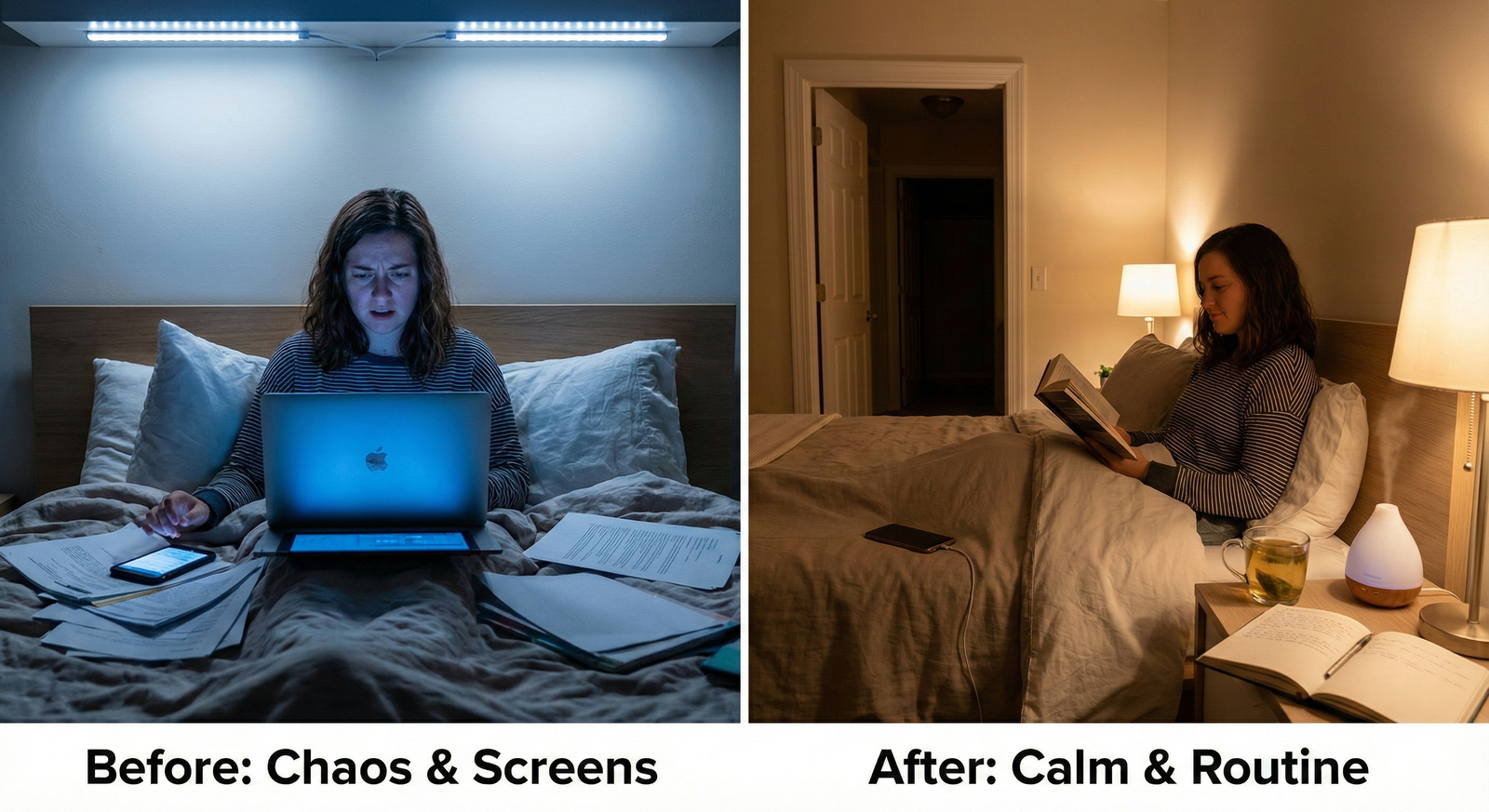
I used to think nighttime routines were for people who had their lives together. You know, the Instagram crowd with their perfect bedside setups and silk pillowcases. That wasn’t me.
My routine was simple: work until exhaustion, scroll my phone, pass out, repeat. And then wonder why I wasn’t sleeping well.
Most nights looked like this: laptop till 11 PM, straight to bed, “five minutes” on Instagram that turned into 45, then lying there wide awake. Some nights I fell asleep eventually, some nights I didn’t. Either way, my mornings were awful.
I kept telling myself I needed to be “more tired.” Turns out, sleep doesn’t work that way. Your body can’t slam from full speed to deep sleep without a transition.
It took me far too long to realize I needed an actual wind-down routine. Nothing fancy—just something that would tell my brain it was time to slow down.
The wake-up call came from my fitness tracker. It showed I was in bed for eight hours but actually sleeping for five or six. Hardly any deep sleep.
I was exhausted all the time, and I couldn’t figure out why. But the truth was simple: I was treating bedtime like an emergency stop.
A friend who sleeps incredibly well told me about her routine. I said I didn’t have time for all that. She pointed out that I was already spending 45 minutes scrolling every night.
That one landed.
I didn’t change everything at once. I began with one step: creating a wind-down window.
An hour and a half before bed, I stopped doing anything stimulating. No emails. No news. No social media arguments.
At first, I didn’t know what to do with that time. I’d been so used to constant input. But I stuck with slow, boring activities—tidying up, washing dishes, just existing quietly.
Within a week, my body started recognizing that this was the time to relax.
My apartment had bright white LED lights that made the place feel like a clinic. I didn’t realize how much they were messing with my sleep until I learned how strongly lighting affects melatonin.
I couldn’t replace all the lights, so I just switched them off earlier and used warm, softer lamps instead.
The vibe changed completely. My home felt gentler. My eyes felt better. Falling asleep got easier in just a few days.
I always took morning showers. They woke me up. Switching to night showers turned out to be a game changer.
Warm water at night releases all that tension you collect during the day. I’d walk out of the bathroom feeling lighter.
The natural drop in body temperature afterward helps trigger sleepiness too. I didn’t believe this until I experienced it myself.
Now, a warm shower around 10 PM is one of the most relaxing parts of my evening.
This one hurt.
I love my evening chai. But caffeine at 7 PM was secretly destroying my sleep.
So I replaced it with herbal teas—mostly chamomile or lavender. At first, it felt sad. But eventually, it became part of the routine.
Sometimes I go for warm milk with a little nutmeg. It’s calming and surprisingly good.
My bedroom used to be my office, dining area, entertainment center—everything.
No wonder I wasn’t sleeping well.
I rearranged the space so it felt more like a bedroom and less like “the room where life happens.” Cooler temperature, dim lights, a small lavender diffuser—all simple changes that made a big difference.
This was the hardest one.
I knew I needed to stop scrolling before bed. But breaking that habit wasn’t easy.
Timers didn’t work. Distance didn’t work.
What worked was putting my phone in another room to charge, about an hour before bedtime.
The first week was uncomfortable. I kept reaching for a phone that wasn’t there. But once I adjusted, the mental quiet it created was incredible.
I started using that time for reading or stretching instead.
My mind used to race at night. So I added two simple habits:
1. Brain dump journaling.
I write down everything that’s on my mind before bed. Tasks. Worries. Random thoughts. Putting it on paper clears my mental space.
2. 4-7-8 breathing.
It slows my heart rate and helps me relax within minutes.
Sometimes I listen to sleep stories or very calm meditations. They give my mind something neutral to focus on.
Screens keep the brain alert. Books do the opposite.
I added 10–15 minutes of reading at night. Light fiction, nothing intense. It helps me shift into a slower, calmer state.
I take magnesium every night. It’s simple and effective for relaxing my body.
On stressful days, I add ashwagandha or an herbal sleep blend. Melatonin made me groggy, so I stopped using it.
8:00–8:30 PM
Finish dinner.
9:00 PM
Start winding down. Lights go dim. Lamps only.
9:30 PM
Phone goes to another room. No screens after this.
10:00 PM
Warm shower.
10:15 PM
Magnesium lotion + supplement.
10:20–10:45 PM
Herbal tea, light stretching, reading, or journaling.
10:45 PM
Get in bed with brown noise or a sleep meditation.
11:00 PM
Usually asleep.
I’m not perfect every night, but even sticking to it most days makes a huge difference.
After a few weeks:
I fall asleep much faster
I wake up less often
My mornings feel manageable
My anxiety dropped noticeably
I have better energy during the day
My irritability is lower
My fitness tracker shows more deep sleep
These small changes added up over time.
Don’t try everything at once
Start with one or two habits
Give your body time to adjust
Choose what fits your life
Focus on consistency, not perfection
Keep it simple
The basics—dim lights, no screens, calming activities—do most of the work.
A nighttime routine isn’t just about sleep. It’s about giving yourself a quiet space where you don’t have to think, produce, or react.
It’s permission to slow down.
My routine has become the most peaceful part of my day. And even though my sleep isn’t perfect, it’s so much better than before.
If you're struggling with sleep, start small and build your own wind-down routine. Your body just needs the chance to rest.
Here’s to calmer evenings and better nights.
Perks, first drops, sleep science.
Shut Up & SLEEP
© 2025 ZIIST. All rights reserved.
theziist.com