
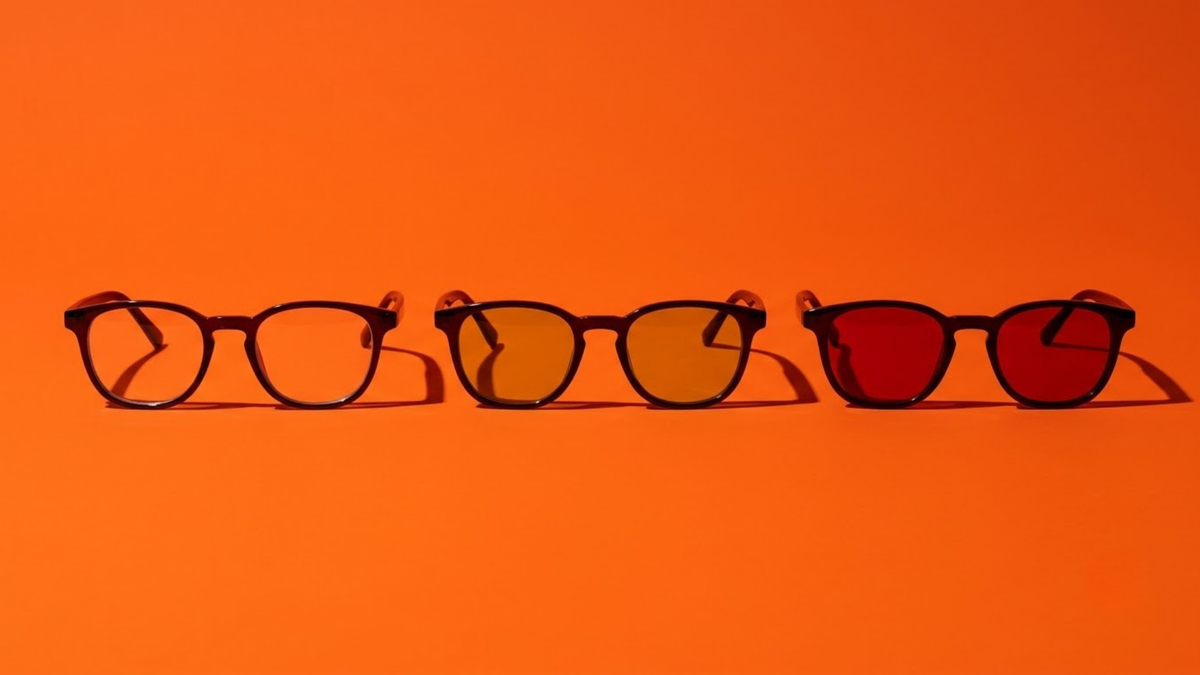
Blue light glasses are heavily marketed and badly explained. Two claims get made about them and only one has decent evidence behind it.
What blue light is
Blue light is simply the higher-energy, shorter-wavelength part of visible light, roughly 400 to 500 nanometres.
The largest source by an enormous margin is the sun. Screens emit it too, at a small fraction of daylight intensity — a fact that rarely appears in marketing.
It has a real biological role: specialised retinal cells detect blue wavelengths and use them to tell your master clock that it is daytime. That is the mechanism behind the sleep claims, and it is genuine.

The sleep claim is the stronger one. Evening blue light suppresses melatonin and delays circadian timing, and studies of blue-blocking eyewear worn before bed have reported improvements in sleep onset and quality.
The eye strain claim is weaker. Systematic reviews, including Cochrane work, have found limited evidence that blue-light-filtering lenses reduce digital eye strain compared with standard lenses.
Digital eye strain is driven mainly by reduced blink rate, sustained near focus, poor ergonomics, dry air and uncorrected prescriptions. Blue light is not a major contributor.
Most Indian marketing leads with the eye strain claim, which is the less supported one. That is worth knowing before you buy.

Decide the purpose first — sleep or daytime comfort. This determines the tint you need.
For sleep, look for amber, orange or red lenses that block a substantial proportion of blue wavelengths. Clear lenses block very little.
For daytime screen use, a lightly tinted lens is more practical, though the benefit is modest.
Check whether the product states what percentage of which wavelengths it blocks. Most do not, which is itself informative.
If you wear a prescription, a blue-filter coating added to your existing lenses is usually more practical than a second pair.
This is the honest tension in the category, and it cannot be marketed away.
Lenses that block blue light effectively have a visible amber or red tint, because they are removing part of the visible spectrum. That tint shifts colour perception.
Clear lenses claiming blue blocking typically filter only a small proportion, often concentrated in violet wavelengths that matter least for circadian signalling.
So the more effective a pair is for sleep, the less suitable it is for colour-critical work. There is no version that is both maximally effective and visually neutral. Any product claiming otherwise is overstating.

Screen at or slightly below eye level, roughly an arm's length away
The 20-20-20 practice: every 20 minutes, look at something 20 feet away for 20 seconds
Deliberate, full blinking — blink rate drops substantially during screen work
Ambient lighting matched to screen brightness rather than a bright screen in a dark room
An up-to-date eye examination, since uncorrected refractive error is a very common and frequently missed cause
For evening use with genuinely tinted lenses aimed at sleep, blue light glasses have a sound mechanism and reasonable supporting evidence.
For daytime eye strain, the evidence is weak and ergonomics will do considerably more.
Buy them for the sleep application, wear them in the two to three hours before bed, and treat any claim about eliminating eye strain with scepticism.
This article is for general information and is not medical advice. Persistent eye discomfort or vision changes warrant examination by a qualified optometrist.
Perks, first drops, sleep science.
shut up & sleep
Also Available on


© 2026 ZIIST. All rights reserved.
theziist.com