
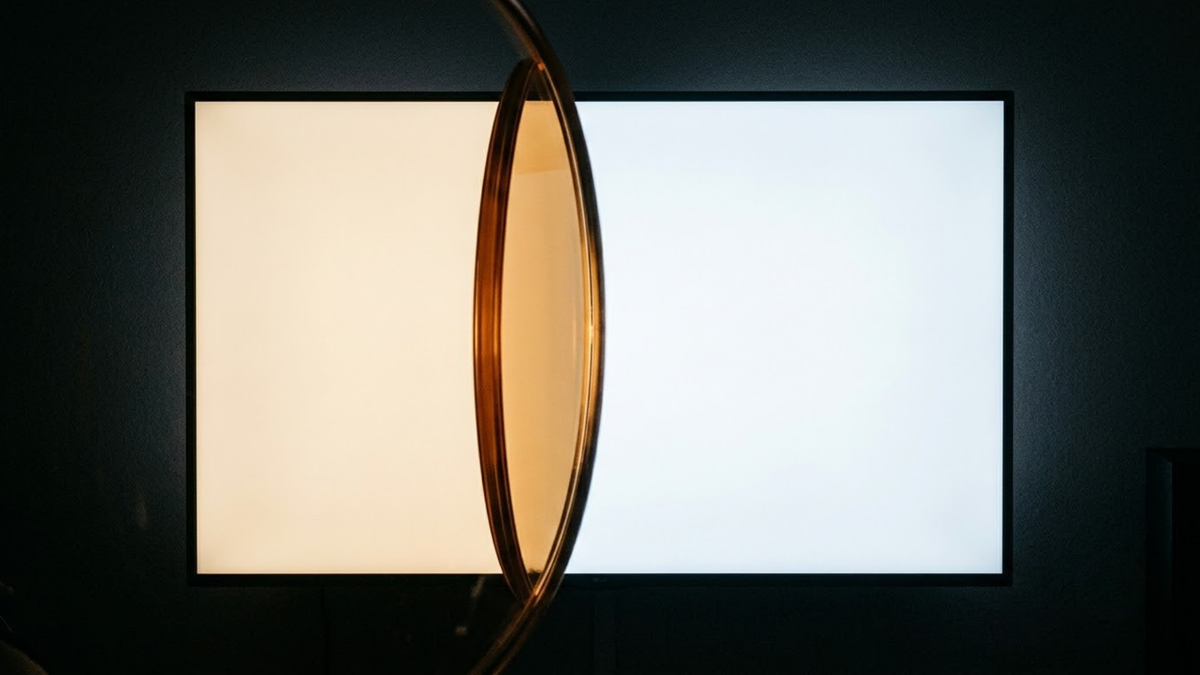
You cannot measure spectral transmission at home. You can absolutely establish whether your lenses do something or nothing, which is the question most people actually have.
The simplest and most informative.
Find a strongly saturated blue object — a blue book cover, a blue folder, a blue app icon
Look at it in good light with your naked eye
Look at it through one lens, covering the other eye
Compare
A lens filtering meaningfully makes the blue look noticeably duller, greyer, or shifted toward green. A lens filtering very little leaves it essentially unchanged.
No difference at all means minimal filtering in the visible blue range.

This indicates overall tint strength.
Open a blank white document or plain white image, full screen
Set brightness to a comfortable level
Look at it through the lens
Amber and effective lenses render white as distinctly warm, cream or orange-tinged. Light filtering gives a faint warmth. No perceptible change means very little filtering.
White contains all wavelengths, so removing blue produces an immediately visible warm shift. That is what makes this test useful.

The most controlled of the three.
Display a pure blue colour block on your screen using a colour picker or solid-colour image
Note how it looks normally
View it through the lens
Strong filtering makes pure blue appear substantially darker, greyer, or nearly black. Weak filtering leaves it recognisably blue.
Repeat with pure red and pure green. Those should change relatively little, since the lens is meant to filter blue specifically. If everything darkens equally, you own sunglasses rather than a selective blue filter.

They give you 'substantial', 'some' or 'minimal' — not a percentage
They cannot identify which specific wavelengths are filtered, and violet-end versus mid-blue matters considerably for sleep
They say nothing about UV protection, which is a separate property
Your perception adapts within a minute, so make the comparison quick rather than staring through the lens first
Reading your result
Strong change across all three — substantial filtering, suitable for evening sleep use
Moderate change — some filtering, likely light amber, modest benefit
Minimal or no change — very little filtering in the visible blue range. Not useless as glasses, but unlikely to deliver the sleep effect the research describes.

If sleep was the goal, you need a genuinely tinted pair — amber or red — worn in the two to three hours before bed.
If daytime screen comfort was the goal, the honest answer is that even a strongly filtering pair has weak evidence for that, so the upgrade would not help either. Breaks, ergonomics and an eye examination will.
This article is for general information and is not medical advice.
Perks, first drops, sleep science.
shut up & sleep
Also Available on


© 2026 ZIIST. All rights reserved.
theziist.com