
Almost no anti blue light product in India states what it actually filters. Here is how to work it out yourself.
The specification that matters
A meaningful product states the percentage of blue light blocked and the wavelength range over which it blocks.
The distinction matters more than it sounds. Blue light spans roughly 400 to 500 nanometres, but the portion most relevant to circadian signalling sits around 460 to 480 nm, where melanopsin receptors are most sensitive.
A lens blocking 90 percent at 400 to 420 nm — the violet end — while blocking 5 percent at 470 nm can honestly advertise high blue-blocking while doing very little for sleep. This is common and technically truthful.

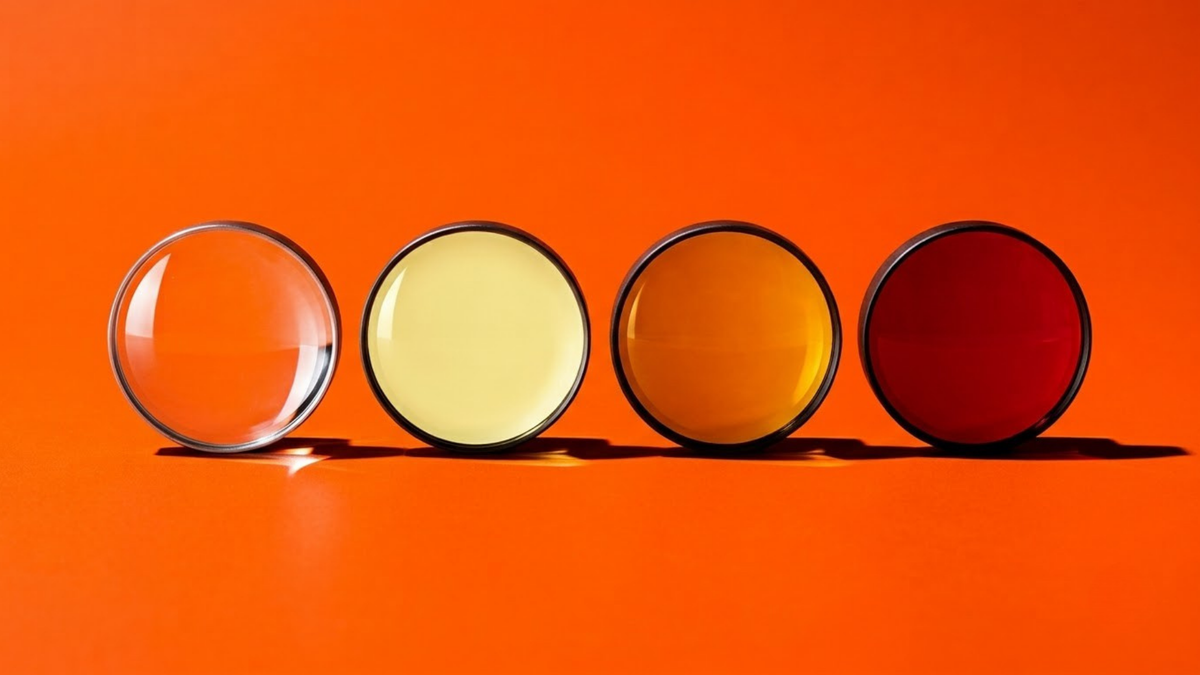
Without a spectral transmission chart, tint is your most reliable indicator.
Clear — blocks a small percentage, concentrated at the violet end. Minimal circadian effect.
Light yellow — modest blocking, some effect, minimal colour distortion.
Amber or orange — substantial blocking across the relevant range. This is the tier most sleep research used.
Deep red — blocks the most, for people prioritising sleep above all, with substantial colour distortion.
The physics is unavoidable. Blocking a wavelength means not transmitting it, which means you see less of it. Visible tint is the honest signal.

Two manufacturing approaches exist, and they age differently.
Embedded filtering has the compound within the lens material itself — durable, and it does not degrade with cleaning.
Coatings are applied to the surface. Cheaper, and they can scratch or wear over time, reducing effectiveness sometimes without any visible sign.
If a pair is a year old and heavily used, coating-based filtering may have declined.

What percentage of blue light is blocked, and across which wavelength range?
Is a spectral transmission chart available?
Is the filtering embedded in the lens material or applied as a coating?
Is there any third-party testing?
A seller who can answer these is selling a considered product. A seller who cannot is selling a label.
The quick home check
Look at a strongly blue object through one lens — a blue book cover, a blue app icon.
Effective blue blocking noticeably dulls, greys or shifts it. If the blue looks essentially unchanged, the lens is filtering very little in the range that matters.
This takes ten seconds and tells you more than most product pages will. A fuller set of home tests is covered separately.

If your lenses test weak and sleep was the goal, you need a genuinely tinted pair — amber or red — worn in the two to three hours before bed.
If your lenses test weak and daytime screen comfort was the goal, the honest answer is that even a strongly filtering pair has weak evidence for that. Your effort is better spent on breaks, ergonomics and an eye examination.
This article is for general information and is not medical advice.
Perks, first drops, sleep science.
shut up & sleep
Also Available on


© 2026 ZIIST. All rights reserved.
theziist.com