
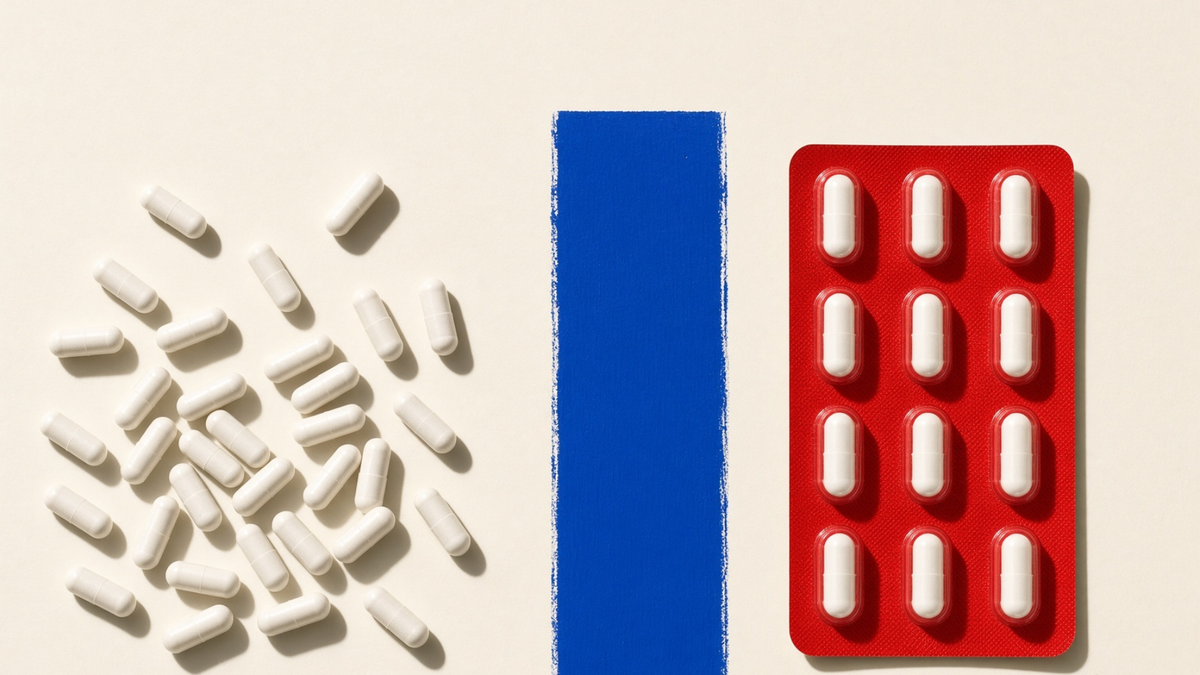
These get shelved together and discussed together, and they are fundamentally
different classes of thing.
This matters because choosing the wrong one wastes months — or creates a
dependence problem that did not need to exist.
Important note up front: this article is educational. Prescription sleep
medication requires a doctor. Nothing here is a recommendation to start or
stop any prescribed treatment.
Melatonin is a timing signal. It is a hormone your body already produces, telling
your brain that biological night has begun. It does not sedate you; it shifts
when your body expects to sleep.
Prescription sleeping pills are sedatives. Benzodiazepines and Z-drugs act on
GABA receptors — GABA being the nervous system's main inhibitory
neurotransmitter — and suppress central nervous system activity. They induce
sleep by dampening arousal.
One tells your clock it is night. The other switches the lights off at the mains.
They are not stronger and weaker versions of each other.

This is the most consequential difference.
Prescription sedatives carry well-documented risks of tolerance, where the
same dose stops working, and physical dependence, where stopping produces
withdrawal including rebound insomnia often worse than the original problem.
This is why they are typically prescribed for short periods.
Melatonin does not appear to produce comparable physical dependence or
tolerance escalation. Psychological reliance is possible, but that is a different
and more manageable problem.
This distinction alone explains why melatonin is available over the counter and
sedatives require a prescription.

Melatonin suits circadian problems:
• Jet lag
• Shift work sleep disruption
• Delayed sleep phase
• A body clock out of sync with the schedule you need
Prescription sedatives are prescribed for short-term severe insomnia, typically
where sleeplessness is significantly impairing function and other approaches
have not worked.
If your sleep problem is that your clock is wrong, a sedative is the wrong tool
and carries risk you did not need to take. If your sleep problem is severe
insomnia, melatonin will likely disappoint you.
A point that rarely appears in the comparison.
Sedatives increase time spent asleep, but research indicates they can alter
sleep architecture — reducing the proportion of deep and REM sleep. You
sleep longer, but the composition of that sleep changes.
This is part of why people can sleep eight hours on a sedative and still wake
unrefreshed.
Melatonin taken at appropriate doses has less impact on architecture, because
it is shifting timing rather than suppressing arousal.

Cognitive behavioural therapy for insomnia — CBT-I — has stronger evidence
for chronic insomnia than any medication, and its benefits persist after
treatment ends, which is not true of sedatives.
It is recommended as first-line treatment for chronic insomnia in multiple
clinical guidelines. It is also substantially under-used in India, where the default
path runs straight from complaint to prescription.
If you have had insomnia for more than three months, this is worth raising with
your doctor before anything else.

• Mechanism — melatonin signals timing; sedatives suppress arousal
• Availability — melatonin over the counter; sedatives prescription only
• Dependence risk — low for melatonin; significant for sedatives
• Best suited to — melatonin for circadian misalignment; sedatives for
short-term severe insomnia under supervision
• Sleep architecture — melatonin largely preserves it; sedatives can alter
it
• Duration of use — melatonin situationally with breaks; sedatives shortterm only by design
If your body clock is the problem, melatonin is the appropriate tool and carries
far less risk.
If you have genuine chronic insomnia, neither melatonin nor a permanent
sedative prescription is the answer — CBT-I is, and it is worth asking for by
name.
This article is for general information and is not medical advice. Never start,
stop or change prescription medication without your doctor. Persistent
insomnia warrants proper assessment.
Perks, first drops, sleep science.
shut up & sleep
Also Available on


© 2026 ZIIST. All rights reserved.
theziist.com