
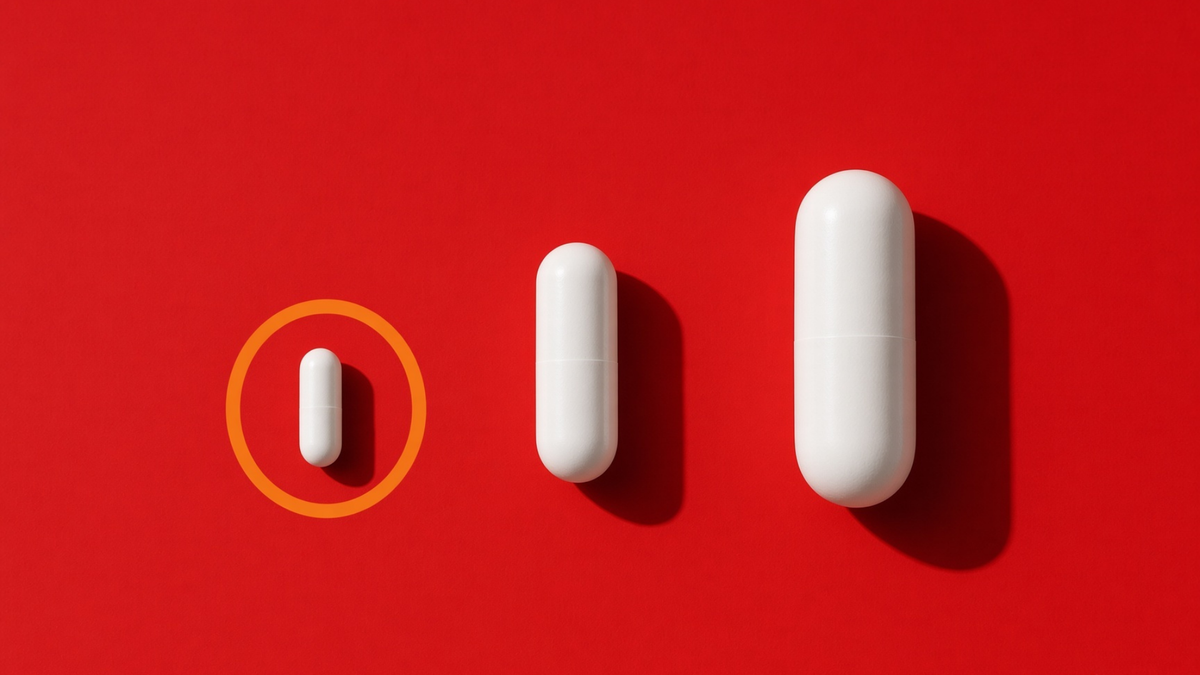
3 mg is the default melatonin strength on Indian shelves, and it is a reasonable
place to start.
It is also, for a lot of people, more than they need. This is one of the few
supplements where the research points firmly toward taking less.
Start with the baseline, because it reframes everything.
Natural night-time melatonin peaks at roughly 10 to 60 picograms
per millilitre of blood. A picogram is a trillionth of a gram.
A 3 mg tablet raises blood melatonin far above that natural peak — by a wide
multiple. A 10 mg tablet takes it further still.
So the question is not whether 3 mg is enough. It is whether it is already more
than the signal your receptors are built to read.

Studies comparing melatonin doses have repeatedly found that low doses
perform as well as, and sometimes better than, high ones for shifting sleep
timing.
Doses in the 0.5 mg to 1 mg range have been effective in research on circadian
shifting, jet lag and delayed sleep phase. Some work has found higher doses
produce more daytime grogginess without improving sleep onset.
The proposed explanation is receptor saturation. Once melatonin receptors are
occupied, additional melatonin does not produce a proportionally stronger
response — it simply extends how long elevated levels persist, which is precisely what causes morning grogginess.

Largely commercial rather than physiological.
Lower-dose products are harder to manufacture consistently, less impressive
on a label, and harder to market. 3 mg became a convention, then 5 mg and 10
mg followed as products competed on visible strength.
None of that reflects a finding that higher doses work better.
• Take it 60 to 90 minutes before your target sleep time, not at bedtime
• Dim the lights afterwards — bright light will undercut it entirely
• Keep the timing consistent night to night
• If you wake groggy, split the tablet rather than changing product
• Give it a week at consistent timing before judging it
Consider splitting to 1.5 mg or less if:
• You wake feeling groggy or heavy
• You experience vivid dreams you would rather not have
• You are over 55, since melatonin clearance slows with age
• You are using it for jet lag rather than a chronic timing issue
• You are new to melatonin and establishing tolerance
Most immediate-release tablets can be split. This is the cheapest possible
experiment.

Being fair to the higher doses, there are situations where a larger amount may
be considered:
• Significant circadian disruption from rotating shift work
• Substantial time zone shifts of eight hours or more
• Under medical guidance for specific sleep disorders
Even then, the first adjustment should be timing, not quantity. Most people
who conclude 3 mg does not work are taking it too late, with the lights on.

Start at 3 mg or split it to 1.5 mg. Take it 90 minutes before bed. Dim the lights.
Hold that for a week.
If it works, stay there. If it does not, adjust the timing before the dose.
Escalating strength is the last thing to try, not the first.
This article is for general information and is not medical advice. Consult a
qualified doctor before starting melatonin, particularly if you take regular
medication.
Perks, first drops, sleep science.
shut up & sleep
Also Available on


© 2026 ZIIST. All rights reserved.
theziist.com