
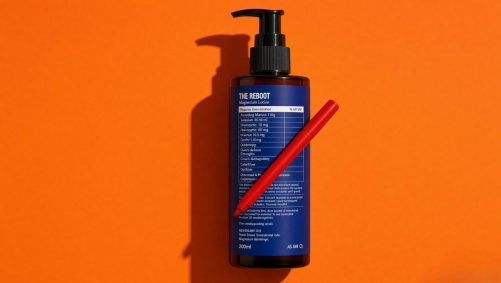
Front labels are marketing. Back labels are information. Here are the six things on the back that decide whether a magnesium supplement is worth buying.
1. Elemental magnesium, not compound weight
The single most important check, and the one most often missing.
Magnesium is always bound to something — glycine, citrate, oxide. Labels sometimes state the total compound weight rather than the elemental magnesium within it, and the difference is large.
Magnesium glycinate is roughly 14 percent elemental by weight. A '500 mg magnesium glycinate' tablet delivers around 70 mg elemental — not 500.
If the label does not say 'elemental magnesium', you cannot compare it against anything.

The form should be named explicitly, not hidden behind 'magnesium complex' or 'chelated magnesium'.
Glycinate — best for sleep, well absorbed, gentle
Citrate — well absorbed, laxative at higher doses
Oxide — cheapest, poorly absorbed, dominates budget Indian products
Blends — check whether the good form is present meaningfully or as a token
Check how many tablets make one serving. A product advertising an attractive elemental figure often defines a serving as two or three tablets.
That changes both your daily routine and your real cost per day. Calculate: elemental per serving, times servings per day, gives actual intake. Then pack price divided by servings gives cost per day.

Many Indian magnesium sleep products are combinations. Reasonable additions:
Glycine — already present if the form is glycinate, and independently linked to sleep quality
L-theanine — reasonable evidence for relaxation without sedation
Melatonin — note this makes it a hormone-containing product with a longer caution list, and dose matters
Vitamin B6 — participates in magnesium transport into cells
Zinc — commonly paired, though evidence for the sleep benefit specifically is thin
Individual quantities must be stated. A 'proprietary sleep blend' total tells you nothing.
An FSSAI licence number should be printed on any oral supplement sold in India. Its absence is enough reason to walk away.
Also look for a named manufacturer, country of origin, batch number and legible expiry date. Third-party testing, where a brand does it, exceeds what the market demands.

A transparent excipient list is easier to assess than a vague one. Check the capsule shell material, since gelatin is common unless stated otherwise, and the vegetarian mark is a legal requirement in India.
For gummies and powders, check added sugar. Sleep gummies frequently carry meaningful sugar content, taken nightly.

Two products, both around ₹800:
Product A — 60 tablets, '500 mg magnesium', form unspecified, one tablet per serving. Almost certainly oxide, elemental content unstated, poor absorption.
Product B — 60 tablets, magnesium glycinate providing 100 mg elemental per serving, two tablets per serving. Delivers 200 mg elemental daily, lasts 30 days.
Product B costs roughly twice as much per day and is clearly the better purchase. Nothing on either front label would have told you that.
This article is for general information and is not medical advice. Consult a qualified doctor before starting magnesium, particularly if you have kidney disease.
Perks, first drops, sleep science.
shut up & sleep
Also Available on


© 2026 ZIIST. All rights reserved.
theziist.com