
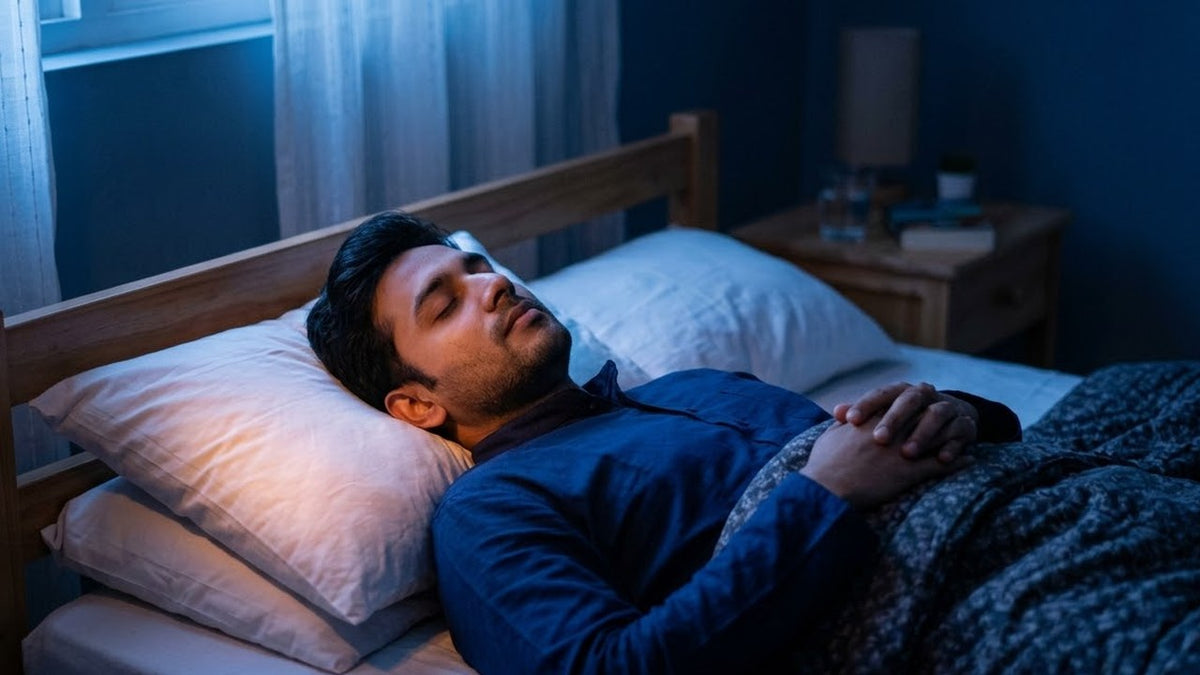
Let's be honest first: no technique reliably knocks you out in five minutes every night. But if you're already reasonably sleepy, the right technique can cut the time it takes to drift off – and with practice, five minutes becomes realistic. These five have the best support.
Made famous by a US Navy pre-flight programme. It works by relaxing the body in sequence:
1. Relax your face completely – forehead, jaw, tongue, the muscles around your eyes.
2. Drop your shoulders as low as they'll go; let your arms go heavy.
3. Breathe out and relax your chest.
4. Relax your legs, thighs to feet.
5. Clear your mind for 10 seconds by picturing a calm scene – or repeat "don't think" silently.
The claim is that it works for most people after six weeks of practice. The practice part matters.

Breathe in through your nose for 4 counts, hold for 7, breathe out slowly through your mouth for 8. Repeat four times. The long exhale stimulates the parasympathetic "rest" response. If holding for 7 feels uncomfortable, shorten all three counts in proportion.
Pick a random word, like "PILLOW". For each letter, picture as many unrelated objects as you can: P – parrot, pencil, pizza; I – igloo, ink... This scrambles the logical, worry-driven thinking that keeps you awake and imitates the random imagery of drifting off. It's especially good for overthinkers.

Tense each muscle group for 5 seconds, then release for 10, working from your toes up. The contrast teaches your body what "relaxed" actually feels like. Studies show it improves sleep onset in people with insomnia.
Your sense of smell links directly to the brain's emotional centres. Using the same calming scent every night – lavender is the best studied – becomes a conditioned cue for sleep. A few spritzes of Unplug Sleep Mist on your pillow, followed by one of the techniques above, stacks two cues together.

· Use these only once you're actually sleepy – they speed up drifting off, they don't create sleepiness.
· Pick one and practise it nightly for two weeks before judging it.
· Keep the room dark and cool, and the phone away.

Perks, first drops, sleep science.
shut up & sleep
Also Available on


© 2026 ZIIST. All rights reserved.
theziist.com